top of page
Jahanikia NeuroLab

Brain Hub
Author: Sanath Beedu
What is Amyotrophic Lateral Sclerosis?
Amyotrophic lateral sclerosis (ALS) is a neurodegenerative disorder associated with degrading motor neurons in the brain and spinal cord, resulting in discomfort, paralysis, and sometimes death. ALS is classified as an orphan disease since it affects less than 1-2 people out of 200,000, resulting in 6,000 cases of ALS per year. It also has a high mortality rate, so patients diagnosed with ALS pass away 2-5 years after symptoms appear. Unfortunately, medical specialists struggle to accurately diagnose ALS due to limited publicly available information, similar symptoms to other diseases, and unsuitable clinical trial designs.
ALS is still very underrepresented visually, with most resources showing only text or static images, which do not represent the full effect on the brain. This does not represent the full effect of the way in which different mutations affect the brain, including the motor regions, the cognitive regions, such as the prefrontal cortex and hippocampus, and deep structures, such as the thalamus and amygdala. This visual underrepresentation limits understanding towards patients, families, researchers, and the public, perpetuating misconceptions about the disease's complexity and impact. present in many cases.
Introduction to ALS Brain Hub
In order to address these gaps in visualization, the ALS Brain Viewer offers an interactive 3D model of how different mutations impact the brain. This allows users to visualize different regions of impact, rotate and zoom in on different sections, and view multiple mutations. The viewer illustrates unique patterns of impact for different mutations, for example, how TARDBP affects motor and thinking regions of the brain, and how C9orf72 affects cognitive regions of the brain, and connects these regions to a real-life brain model. This allows patients to better understand what is going on in their specific case, allows researchers to identify patterns across different mutations, and allows doctors to more easily explain what is going on with the disease.
How its built
The ALS Brain Viewer uses React and Three.js to render an interactive 3D brain from AAL3 atlas data converted into 272 mesh files. Mutation data linking ALS mutations to affected brain regions is stored in JSON files.

2D slices through AAL3v1 human brain atlas
How it works
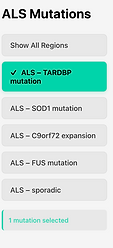
The user can click on a mutation in the left sidebar, and the 3D model will display the regions that are affected by that particular mutation while the other regions will be faded out.
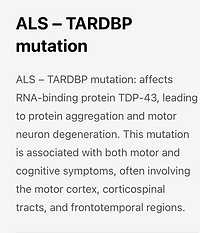
Each region can be clicked to see information about that particular mutation and its effects on that region of the brain on the right sidebar. This makes it very easy to see the effects of different mutations on different brain regions


bottom of page